

The U.S. Senate race in Texas is quickly shaping up to be one of the most contentious elections across the country for the 2026 cycle. Since 2003, the seat has belonged to Sen. John Cornyn, R-Texas, who is aiming for a fifth term.
Rep. Jasmine Crockett, D-Texas, began her public service career in Bowie County as a public defender. Crockett said serving in that role inspired her to create change in the criminal justice system and she ran for district attorney in Texarkana, but was handed a loss.
Ten years later, Crockett ran and won a state House seat in the Dallas area. She served one term before setting her sights on Capitol Hill, when former Rep. Eddie Bernice Johnson announced she would not seek reelection in Texas’s 30th Congressional District.
Crockett, backed by Johnson, ran and won the election to the U.S. House and is currently serving her second term.
Now she’s running for U.S. Senate, but first she needs a win in the Democratic primary against State Rep. James Talarico, D-Round Rock.
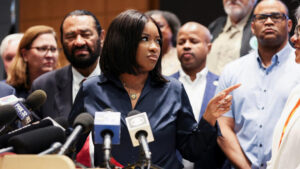
Capitol Correspondent Dylan McKim interviewed Crockett during one of her campaign stops in east Fort Worth. This is the fifth in Nexstar’s series of profiles on the candidates running to be the next U.S. Senator from Texas. The following transcript is only edited for clarity and readability.
Full interview with Jasmine Crockett by Dylan McKim

Dylan McKim: First of all, I want to thank you very much for taking time out of your very busy schedule in the campaign. You’ve been campaigning since December 8th officially now.
Jasmine Crockett: Not even two weeks old, yeah.
DM: Yeah. I want to first just ask, how are things going? Was it what you expected?
JC: I don’t know what I expected, to be perfectly honest. I will say that if there’s been any surprises, I did not expect to be attacked immediately. That’s probably the biggest surprise. But as it relates to the part of campaigning that I love, which is the people, that’s actually been overwhelming.
Obviously I serve in Dallas and so my base is right there in Dallas County. So, you know it makes sense for me to go home in Dallas and things be exciting, but to be in Houston, Texas and to have people be so excited and want pictures and really be encouraged by my candidacy.
Or to come over now, today, to Fort Worth, an area that I’ve never represented, and to have kind of the same reception, it’s making me believe even more, right? Because the theory of my case has always been that we could expand the electorate, we could get people that normally don’t participate in politics to be excited about getting involved.
And so many people have said over and over, “Oh, Democrats always say they’re going to expand the electorate,” right? And so I think that there is a bit of cynicism around kind of my approach. But in reality, when I touch grass and when I see people, I feel it and it comports with what we were seeing and kind of our way of trying to test to see if my candidacy would get some of those people that normally don’t participate to get involved.
DM: I want to go into your background. When you first got into public service, you were a public defender in Bowie County, Texas. That’s Texarkana area for people who don’t know.
What did that job teach you as a person and serving the public?
JC: Yeah, so it was actually my experience as a public defender that got me involved in politics in general. A lot of things had to come together, but overall my experiences were what really drove me.
And so my very first race for public office, the only one that I lost, was for a district attorney. And that was in Texarkana. And a lot of people were like, “what are you doing? You’re 28 years old. You’re fresh out of law school, and you’re running to be DA?” And I was like, “Yes, because I can do better,” right? I raised $7,000, and I thought, you can’t tell me nothing. Like, I raised $7,000, I’m about to win this thing, right?
And truly it was God preparing me for my future. It was in that race that I learned so much about what it was to campaign and that kind of stuff. But the catalyst for me joining was I was representing a 17-year-old.
And the 17-year-old — I got him on what we call a probation revocation — so he had been placed on felony probation for burglary of a building. His crime was stealing candy out of the concession stand at his high school. Now, I don’t condone theft, but at the same time, I was like, are we seriously giving somebody a felony for burglary? I mean, when he goes to get a job in the future, it doesn’t lay out the specifics of the case. It just has a charge.
And I’m like, why would we give a 17-year-old burglary of a building? But unfortunately some lawyer before me put him on felony probation. And when his mom was unable to take off work, to go get her son from school, get him to the probation officer, they filed a probation revocation on him. It was all technical violations, no new offenses, no dirty waves, nothing like that. It was all technical.
And I had to represent him and that judge gave him the maximum penalty of two years in a state jail facility. The next time that I saw him again he was a full blown — I don’t want to call him a full-blown criminal — but he had definitely gotten involved in the criminal world for sure.
DM: He advanced from the concession stand.
JC: Correct. He advanced. And I had actually gotten him on a meth case, to be honest. And I was like, “Where did you get this from?” And he learned how to cook meth in prison. That is where he learned and so I was just like, how did this help our community?
How did this help our society? We took a kid who obviously, you know, again, not condoning theft, but like, if I think about something that a kid may do, that sounds kind of like a kid-like thing.
And that was when I was so frustrated that Texas is only one of five states that at the age of 17 you are considered an adult, but only for criminal justice purposes. So I’m like, why is it we haven’t gotten in alignment with the federal law? Why is it that we haven’t changed it to 18 when you get someone who’s charged with capital murder? Because of what federal law says, it’s not like they’re ever facing the death penalty, because federal law says you can’t do it.
So I’m like, this makes life really complicated. And you always have an option to certify young people who, say, have a significant juvenile record. You can always certify somebody. So it’s not that you can’t charge somebody as an adult, but why were we starting there? So, these are the questions that started to go off in my head.
But for me, I was like, well, the prosecutor was the problem. The prosecutor had the power to decide I’m going to reduce this to a misdemeanor, or I’m going to go ahead and give them a diversion option.
And so when I ran back then, I came up with a diversion program where if someone had a low-level — even felony — and it was nonviolent in nature, that we should give them the option of going into the military. And if they chose to go into the military, then they would not necessarily have to face the charges for something like stealing candy out of the concession stand.
And I just thought this is doing so much more for our community. And so I was making that case. And so at 28 with $7,000, I won the early vote and lost on election day. So it was a huge accomplishment. But at the time, my pastor was a Reverend Petrie in Texarkana.
And I had talked to him for a while about, I think this is what God is leading me to do, but I don’t know. This is kind of scary. This is weird. And that was when he told me, I believe God really is speaking to you, but I want you to understand that just because He’s telling you to run doesn’t necessarily mean that you’re going to win in this moment.
And he was like, “I need you to be okay no matter what happens. Not saying that I don’t think you’re going to win.” And it truly laid the foundation for ultimately my state house race that came 10 years later.
DM: Yeah, let’s talk about that. Was it a narrow defeat at least?
JC: I don’t remember. It wasn’t like super big because there was a former Republican who was like, “There’s a history of throwing ballots out in this,” because we still did paper ballots. And he’s like, “They have been known to throw things out. You should go and sue.” And I was like, no, it’s all good. I’m like, it’s fine, you know, because I really was settled in give it your all and trust the process.
Like trust that this is what God really put on your heart and I never could have imagined we’d be where I am now. But if I had become DA, I don’t think I would have ultimately ended up in Dallas and ultimately gone to the state house, US House, and now be running for the Senate.
DM: So you were 0 for 1. You moved back to Dallas. You started your own law firm, and then you said, “I’m going to take another crack at this,” but you’re going for, I would argue, a bigger position going to the state House in Austin. What was the reasoning? To go spark change for the criminal justice system? Was that the main reason?
JC: That was, yeah, so still being frustrated with the system, right? 17-year-olds, again, as the girl who doesn’t have any kids, right?
So as I continue to practice law throughout the entire state of Texas, having 17-year-olds get charged with, like, vape pens and Rice Krispie treats and brownies, because they don’t understand that as soon as you add anything to whatever flower you have, now you’re facing a felony.
They didn’t understand that it’s all that weight. And so, like, don’t do it, right? And again, not condoning, but seeing kids end up with felonies, depending on what county they were in and how good the prosecutor was, these drug felonies would prevent them then from being able to get the financial aid on the federal level so that they could go to college.
